|
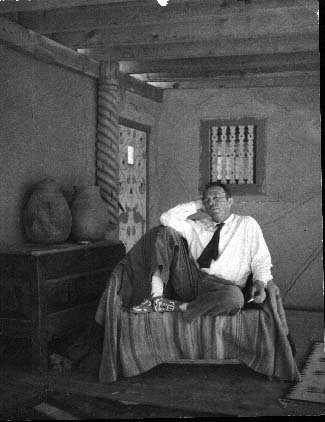 Ralph Meyers,
was the "Good White Trader" in Frank Waters Classic, The Man Who Killed
The Deer. In 1909 Ralph opened The Mission Shop, the first
Indian curio shop in Taos. Ralph Meyers,
was the "Good White Trader" in Frank Waters Classic, The Man Who Killed
The Deer. In 1909 Ralph opened The Mission Shop, the first
Indian curio shop in Taos.
He
traveled to the surrounding reservations, buying and trading
with knowledge and understanding. Few white men were as well
loved and accepted by the Taos Pueblo Indians. But this was not
always the case.
When
Ralph first arrived, he spent his days at the Pueblo, causing
great suspicion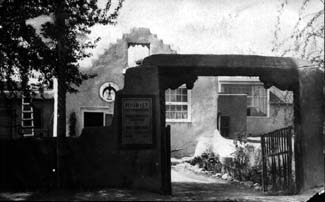 among
the Indians. They wondered who this strange white man was and
what he wanted. Some believed that he must be after their women,
so it was decided that they were either going to kill him or
offer him a bride. Fortunately for us, they chose the latter,
which he politely declined. He wished only to observe and enjoy
the timeless and beautiful surroundings. among
the Indians. They wondered who this strange white man was and
what he wanted. Some believed that he must be after their women,
so it was decided that they were either going to kill him or
offer him a bride. Fortunately for us, they chose the latter,
which he politely declined. He wished only to observe and enjoy
the timeless and beautiful surroundings.
Ralph's
descendants still maintain friendships and enjoy feast days with
the descendants of the same families he befriended long ago.
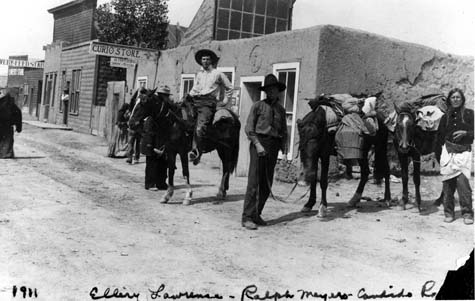
 When
Ralph arrived, Taos was forming a colony of artists, writers
and other people in search of a life of unhurried simplicity.
He easily found his place among them. When
Ralph arrived, Taos was forming a colony of artists, writers
and other people in search of a life of unhurried simplicity.
He easily found his place among them.
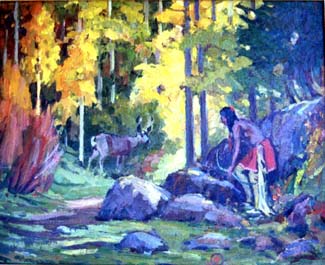
In
these early years Ralph worked as a photographer and taught himself
to paint. He loved color, painting dramatic landscapes and romantic
images of the Native and Hispanic peoples whom he understood
and loved so devotedly. Through his art, he captured a rapidly
disappearing way of life. In the opinion of Russian artist Leon
Gaspard, Ralph was one of the finest colorists of the period.
(Click to visit The Ralph Meyers
Gallery)
In
his shop he made reproductions of Spanish-Colonial furniture,
executing large orders. One such order was commissioned by oilman
Waite Phillips for the Philmont Ranch in Cimarron and the Philbrook
Estate in Tulsa, Oklahoma.
He
had a reverence for Indian culture and arts, studying and learning
many of their traditional techniques. Driven by his love of the
past and need to create, he mastered the art of weaving, spinning
and dyeing wool in the old way. He tanned deerskin and learned
to do beadwork, fashioning fine clothing and ceremonial pieces.
He
was a self-taught silversmith and in his shop he trained and
employed Navajo and Taos Pueblo Indians where they made jewelry
and native craftworks for the growing tourist trade. Their customers
included Millicent Rogers, Mabel Dodge Luhan and Queen Marie
of Romania.
Ralph
corresponded with well known German author, Karl May, supplying
him with items for study and display in his museum collection
in Radebeul, Germany.
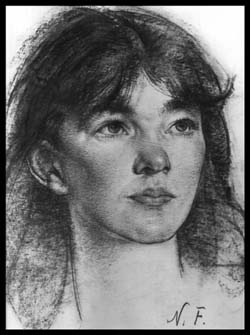 In
1933, Ralph married beautiful, young, Rowena Matteson, twenty
five years his junior. In 1936 they had a daughter, Nina Cristina,
and in 1938, a son, Ouray Emerson, named for Chief Ouray of the
Uncompahgre Utes. Together they ran the In
1933, Ralph married beautiful, young, Rowena Matteson, twenty
five years his junior. In 1936 they had a daughter, Nina Cristina,
and in 1938, a son, Ouray Emerson, named for Chief Ouray of the
Uncompahgre Utes. Together they ran the 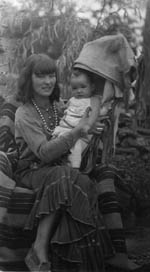 trading post, and opened La
Doña Luz Restaurant, which they operated together until
Ralph passed away in 1948. trading post, and opened La
Doña Luz Restaurant, which they operated together until
Ralph passed away in 1948.
Ralph
was a close friend of Mabel Dodge Luhan and was part of her inner
circle of friends, artists and writers. A patron of the arts,
she brought together many of the famous and soon-to-be-famous
creative talents of the time and introduced them to the magical
and inspiring place she loved so much. Georgia O'Keeffe, Ansel
Adams and D.H. Lawrence were among those she lured to the area.
Ralph
and Mabel often joked about being buried together. Years later
when Mabel passed on, Frank Waters recalled their playful banter
and remarked, "I don't think Ralph would mind moving over
a bit for Mabel". And with Rowena's approval, it was done.
Mabel was buried next to her dear old friend in the Kit Carson
Cemetary...
WESTERN ART AND ARCHITECTURE
Perspective: Ralph Meyers [1885-1948]
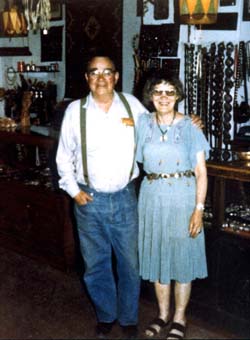 After
Ralph's death in 1948, Rowena closed the shop and married J.
Paul Martinez. After
Ralph's death in 1948, Rowena closed the shop and married J.
Paul Martinez.
Paul
was a direct descendent of Don Severino Martinez, builder of
the Martinez Hacienda in Ranchitos, the best preserved Spanish
Colonial hacienda in North America. Don Severino was a successful
merchant who imported goods from Mexico over the Camino Rael.
Paul's Great, Great Uncle was Padre
Martinez
Through
this marriage Rowena inherited the legacy and historical items
from the Martinez family, many of which are on display in the
Trading Posts' museum.
They
both worked for the Forest Service, and at the time Paul was
a ranger in the El Rito District. Knowing this, Georgia O'Keeffe
asked Paul and Rowena if they would show her around the area
to help her find the place where she would build her home. They
spent several days driving around the area until she fell in
love with the area near Abiquiu, a landscape very familiar to
those who know her work.
Rowena
"retired" in 1970, and reopened the old trading post,
renaming it "El Rincón", the inside corner,
reestablishing the tradition of trading, historic preservation
and education begun by Ralph many years earlier.
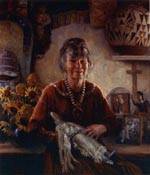
Over
the years, she 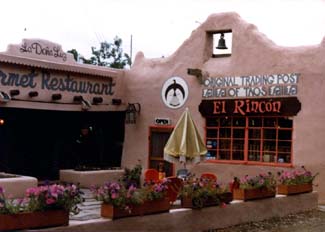 generously
shared her collection of vintage Indian, Spanish and American
Colonial clothing and artifacts, staging historical fashion shows
for the Martinez Hacienda Trade Fair and many other special events. generously
shared her collection of vintage Indian, Spanish and American
Colonial clothing and artifacts, staging historical fashion shows
for the Martinez Hacienda Trade Fair and many other special events.
(Click to view images from The
Historic Fashion Shows)
 In the trading post, she added
a museum to display the diverse collection of items acquired
through many decades of trading with the Native and Spanish people.
Rowena once said it was her "gift to the public". In the trading post, she added
a museum to display the diverse collection of items acquired
through many decades of trading with the Native and Spanish people.
Rowena once said it was her "gift to the public".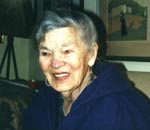
Rowena
passed away March 5, 2000.
Nina
Meyers was born 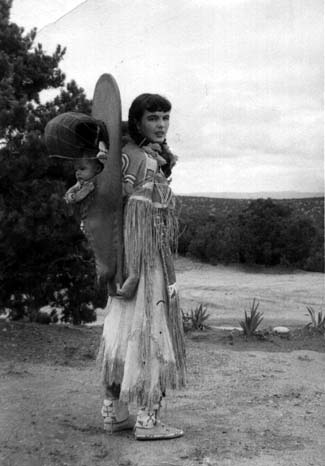 and
raised in Taos and was well versed in its history and traditions.
As a child she grew up knowing many of the historic and colorful
people of Taos, such as Mabel Dodge Luhan, Frank Waters, Lady Brett, Long John Dunn
and many of the early artists. At six months old, she was the
youngest person to attend the memorial service for D.H. Lawrence. and
raised in Taos and was well versed in its history and traditions.
As a child she grew up knowing many of the historic and colorful
people of Taos, such as Mabel Dodge Luhan, Frank Waters, Lady Brett, Long John Dunn
and many of the early artists. At six months old, she was the
youngest person to attend the memorial service for D.H. Lawrence.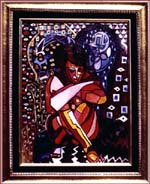
An
artist in her own right, her work is featured throughout the
Inn. In addition to her more serious work, Nina had a great love
of folk art and was influenced by the well known Taos artist,
Gisella Loeffler. Nary a trash can or kitchen cabinet escaped
Nina’s colorful palette and brushes!
Nina passed away July 6th, 2007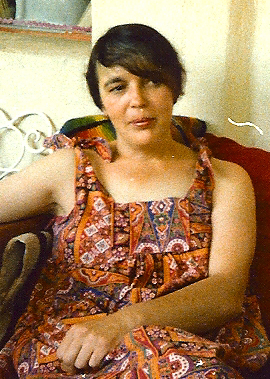
|